
Gut Microbiome testing - Is it worth the investment?
Is Your Gut Trying to Tell You Something? What Midlife Symptoms Really Reveal — And How a Gut Microbiome Test Can Help
TESTING
Antonia Mantakaki Wright BSc, MSc
6/9/20268 min read
You've tried cutting out gluten, taken the probiotics off the shelf at the health food shop, drunk the bone broth and eaten the fermented foods. And yet, the bloating is still there by 3pm. The skin is still developing something like eczema (but to quite!) and your digestion feels sluggish no matter what you do, and, to top it up, your hormones seem to be out of control.
If this sounds familiar, you are not alone. And more importantly, you are not imagining it.
Our body often communicates in frustrating ways. Thanks to a rapidly growing body of clinical research, we now understand that many of these experiences share a common root: the gut microbiome.
This blog explains what the gut microbiome is, why it becomes particularly significant in midlife, what the test actually measures, and how this kind of testing can help you make genuinely informed decisions about your diet, lifestyle, and supplementation (rather than guessing).
What is the gut microbiome?
Your gut is home to trillions of microorganisms like bacteria, fungi, viruses, and archaea which are collectively known as the gut microbiome. These microbes are not passive passengers. They ferment dietary fibres, produce short-chain fatty acids (SCFAs) such as butyrate and acetate, regulate your immune system, synthesise certain vitamins, and influence everything from your mood to your metabolism.
When this microbial community is diverse, balanced, and functioning well, your body tends to follow suit. When it is disrupted — a state known as dysbiosis — the downstream effects can be wide-ranging and deeply personal.

The Hormone–Gut Connection
Oestrogen is known to act on reproductive tissues. However, it actually plays a significant role in regulating the gut microbiome, and this relationship is bidirectional.
As oestrogen levels fluctuate and decline during perimenopause and menopause, microbial diversity can decrease and shift towards a pattern more typically seen in older men. Lower microbial diversity has been clinically linked to increased bloating, slower digestion, and reduced nutrient absorption. At the same time, declining oestrogen and progesterone slow gut motility which is the speed at which food moves through your intestines. This shift helps explain why bowel habits often change in midlife even when diet stays the same.
There is also a specific collection of gut bacteria, known as the estrobolome, which produces an enzyme called beta-glucuronidase. This enzyme plays a key role in regulating how oestrogen is metabolised and recirculated in the body. When the estrobolome is disrupted, it can affect circulating oestrogen levels — creating a feedback loop between gut dysbiosis and hormonal imbalance (Hu et al., 2023, Gut Microbes; Baker et al., 2017, Maturitas). A 2026 review in Nutrients confirmed that greater microbial diversity has been positively associated with improved oestrogen regulation in perimenopausal women (Logan et al., 2026).
For men in midlife, shifts in the microbiome have equally been associated with changes in testosterone metabolism, inflammatory signalling, and metabolic health.
The Gut-Skin axis
If you are experiencing unexplained breakouts, rosacea, persistent dryness, or skin that seems to react to everything, your gut microbiome may be facing changes.
Clinical researchers have identified a clear bidirectional relationship between the gut and the skin, referred to as the gut–skin axis. When the intestinal barrier becomes compromised, inflammatory mediators, microbial metabolites, toxin, and even bacteria themselves can enter systemic circulation and affect skin physiology. A 2024 study concluded that there is a causal relationship between gut microbiota composition and immune-mediated skin conditions. Dysbiosis has been documented specifically in psoriasis, atopic dermatitis, and rosacea.
Bloating and Constipation
Persistent bloating and sluggish digestion are among the most common complaints from people in midlife. These symptoms are often attributor could be dysbiosis. A disrupted microbiome can alter how gases are produced and absorbed, cause imbalances between gas-producing and gas-consuming bacteria, and impair the integrity of the gut lining. Without knowing what is actually happening in your microbiome, any dietary or supplementation changes you make are educated guesses.
What Does a Gut Microbiome Test Actually Measure?
This is where the testing becomes genuinely powerful. The gut microbiome we use at Olympian Wellness Clinic uses shotgun metagenomics — the most comprehensive form of gut microbiome analysis currently available. Rather than targeting a single gene region, shotgun metagenomics sequences all of the genetic material in your stool sample, giving a detailed picture not just of which microbes are present, but what they are functionally capable of doing in your body.
The test is run through a UKAS-accredited laboratory, using a simple at-home stool sample swab. Here is what the results cover:
Core Metrics
- 17 Significant Bacteria — including keystone species that are critical for gut health, hormone metabolism, digestion, and immune regulation
- Microbiome Diversity (Shannon Index) — a clinical measure of the variety of microbial species in your gut, benchmarked against a healthy reference population. Higher diversity is consistently associated with better health resilience
- Intestinal Permeability Index — an assessment of gut lining integrity; elevated permeability (commonly called "leaky gut") is associated with systemic inflammation, skin conditions, and immune dysregulation
- Calprotectin-Linked Dysbiosis Score — a marker reflecting gut-level inflammation and microbial imbalance
- Hydrogen Producers (SIBO indicator) — identifying bacteria that produce excess hydrogen, a key driver of small intestinal bacterial overgrowth, bloating, and gas
- Antibiotic Degradation — revealing whether your microbiome carries resistance genes that could affect future antibiotic treatments
- Cardiovascular Health (TMAO) — measuring the microbial capacity to produce trimethylamine N-oxide, a metabolite linked to cardiovascular risk
Microbial Screen (28 Additional Markers)
The Advanced tier includes screening for organisms beyond bacteria:
- 6 Fungi (including Candida species)
- 5 Parasites
- 9 Pathogenic Bacteria
- 6 Viruses
- 2 Archaea (including methane-producing organisms linked to constipation)
.
A test is only useful if it informs action. Here is what a comprehensive microbiome report makes possible that guesswork does not:
Targeted probiotic selection - Most people buy probiotics off the shelf without knowing whether those specific strains are relevant to their microbiome. A 2026 systematic review and meta-analysis found that generic probiotic supplementation does not produce statistically significant changes in gut diversity in healthy individuals (BMC Medicine, 2026) — which is precisely why personalised, test-guided choices matter. Your results identify which bacterial families are low or absent, allowing for strain-specific recommendations that are actually matched to your biology.
Personalised dietary guidance - Different microbial profiles respond differently to dietary interventions. High-fibre diets, fermented foods, polyphenol-rich foods, and specific prebiotic fibres all interact with the microbiome in ways that depend on what is already there. Testing removes the guesswork.
Supplement rationalisation - Many clients come to me taking multiple supplements with no clear rationale. Test results help prioritise what is genuinely needed — and what can be set aside.
Hormone support through the gut - If oestrogen metabolism is being affected by the state of your estrobolome, dietary and supplementation strategies can be targeted accordingly — something that is impossible to do with confidence without a baseline picture of microbial composition.
A baseline for progress - Testing gives you a starting point. As you implement changes, re-testing allows us to see what is shifting and where further support is needed.
The process is straightforward and entirely done from home:
Step 1: Order your kit
You order the YourGutMap Advanced GI Axis test through Olympian Wellness Clinic or The Good Gut Clinic as your practitioner. The kit is posted directly to your home.
Step 2: Collect your sample
The kit includes clear, simple instructions for collecting a stool sample swab at home — it takes only a few minutes. A pre-paid envelope is included to return your sample directly to the accredited laboratory.
Step 3: Receive your results
Results are returned within 2–3 weeks. The laboratory produces a comprehensive report covering all of the markers, axes, and insights described above.
Step 4: Your 45-Minute Results Consultation
We meet for a dedicated 45-minute consultation in which I walk you through your results, interpitating the clinical data into clear, practical meaning for your body. Together, we build a personalised gut recovery plan covering dietary adjustments, targeted probiotic and supplement recommendations, lifestyle considerations, and a clear roadmap for improving the areas your results highlight.
How the Service Works
What This Testing is and is Not
Gut microbiome testing is a powerful and evidence-informed tool. It is not a diagnostic test for disease, and it is important to be transparent about that. What it provides is a detailed picture of your microbial ecosystem, benchmarked against healthy reference populations, which forms the foundation for genuinely personalised lifestyle and nutritional guidance.
The science in this area is moving rapidly. What we can say with confidence is that microbial composition meaningfully influences digestion, hormone metabolism, skin health, immune regulation, and inflammation. All the information we share is backed by peer-reviewed clinical research. Testing gives you access to that information about your own body, rather than relying on population averages or trial and error.
Who Is This For?
This service is particularly well suited to you if you are in you are experiencing one or more of the following:
- Persistent bloating, gas, or abdominal discomfort
- Constipation or unpredictable bowel habits
- Skin issues including breakouts, rosacea, or unexplained flare-ups
- Hormonal imbalances including perimenopausal or menopausal symptoms
- Fatigue or low energy that does not resolve with rest
- A sense that your body is no longer responding to the approaches that used to work
If you have already tried dietary changes, generic probiotics, or other approaches without sustained results, testing may reveal exactly why, and what to do instead.
Ready to Get Answers?
Your symptoms are real. They are not simply the price of getting older. And with the right information which is specific to your gut, there is a great deal that can be done.
References
- Bharwani, A. et al. (2020). Microbiome diversity and its association with gut symptoms in perimenopause.
- Baker, J.M., Al-Nakkash, L., & Herbst-Kralovetz, M.M. (2017). Estrogen–gut microbiome axis: Physiological and clinical implications. Maturitas, 103, 45–53.
- Hu, S. et al. (2023). Gut microbial beta-glucuronidase: A vital regulator in female estrogen metabolism. Gut Microbes, 15, 2236749.
- Kim, Y. & Kim, K. (2021). Gut motility changes and hormonal decline in midlife women.
- Logan, S. et al. (2026). Diet, the Gut Microbiome, and Estrogen Physiology: A Review in Menopausal Health and Interventions. Nutrients, 18(7), 1052.
- Feng, F. et al. (2024). Causal relationship between gut microbiota and immune-mediated skin conditions. Cited in: Do, N.M. et al., American Journal of Lifestyle Medicine (2024).
- Chai, J. et al. (2024). The gut-skin axis: interaction of gut microbiome and skin diseases. Frontiers in Microbiology, 15, 1427770.
- Éliás, A.J. et al. (2026). Effect of probiotic supplementation on the gut microbiota diversity in healthy populations: a systematic review and meta-analysis of RCTs. BMC Medicine.
- Dubois, N. et al. (2025). Efficacy of Gut Microbiome-Targeted Interventions on Mental Health Symptoms in Women Across Key Hormonal Life Stages. Healthcare, 13(22), 2851.
What Changes With Testing?
10 Gut Health Axes
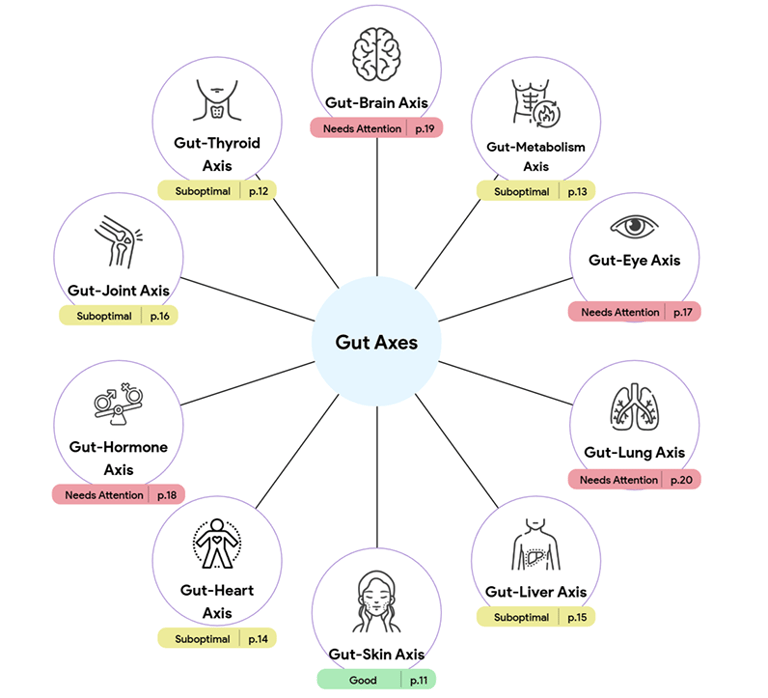
One of the most clinically meaningful elements of this test is how it maps your microbiome against ten body systems — showing where gut dysbiosis may be creating downstream effects:
- Gut–Hormone Axis — directly relevant to the oestrogen/testosterone imbalances many midlife clients experience
- Gut–Skin Axis — assessing the microbial drivers behind inflammatory skin conditions
- Gut–Brain Axis — the gut–mood connection, including neurotransmitter precursor production
- Gut–Metabolism Axis — relevant to weight management, blood sugar regulation, and energy
- Gut–Thyroid Axis — how microbial balance affects thyroid hormone conversion and function
- Gut–Liver Axis — detoxification pathways and liver burden
- Gut–Heart Axis — cardiovascular risk markers derived from microbial activity
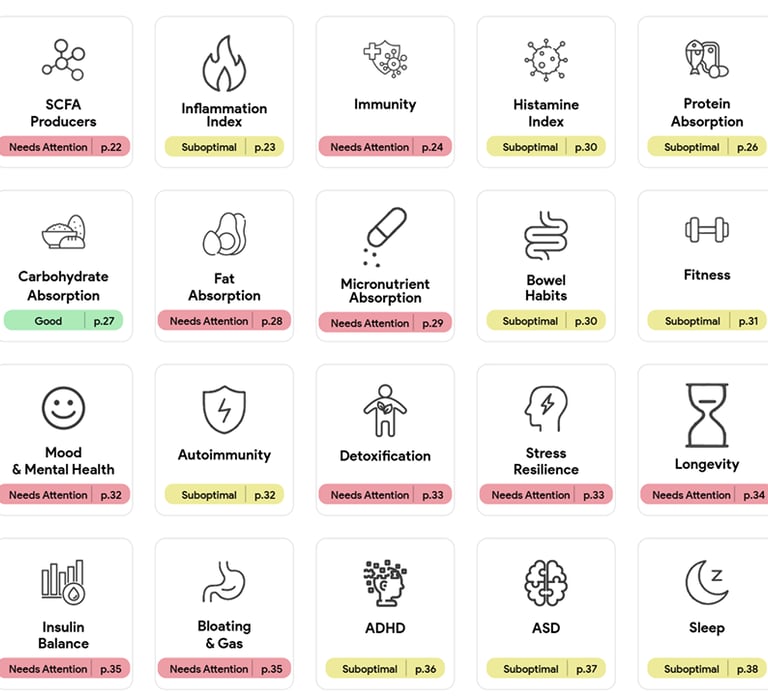
20 Gut Interaction Insights
The test then translates your microbiome data into 20 personalised health insights — the areas where your specific microbial profile is directly affecting how you feel day to day:
SCFA Producers · Inflammation Index · Immunity · Sleep · Protein Absorption · Fat Absorption · Carbohydrate Absorption · Mood & Mental Health · Autoimmunity · Detoxification · Stress Resilience · Longevity · Insulin Balance · Bloating/Gas · Vitamin Absorption · Bowel Habits · Histamine Index · Fitness · ADHD · ASD
For midlife clients, the most immediately relevant of these tend to be: bloating/gas, bowel habits, hormone axis, inflammation index, sleep, mood, and detoxification — though your individual results will tell us where to focus first.
- Gut–Joint Axis — inflammation markers relevant to joint pain and autoimmune conditions
- Gut–Lung Axis — the gut–immune–respiratory connection
- Gut–Eye Axis — emerging research on ocular health and microbiome
Olympian Wellness Ltd trading as Olympian Wellness Clinic
Registered address: 57 High St, Hanham, Bristol, BS15 3DQ
company number: 16675182
© 2026. All rights reserved.